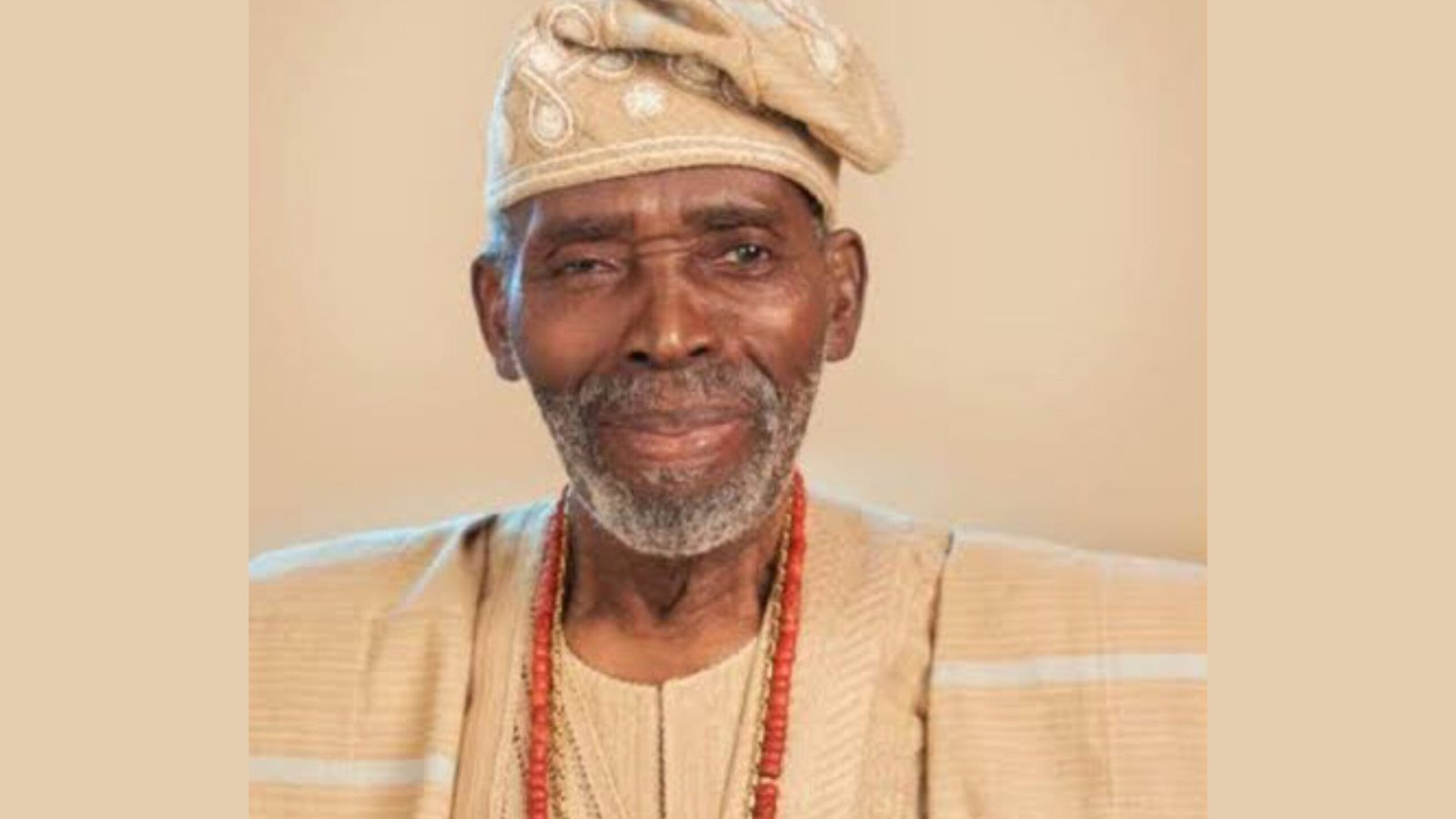
There are actors who become famous because of the characters they play and there are those whose presence eventually becomes larger than the characters themselves. Olu Jacobs belonged firmly to the second category. For more than five decades, Oludotun Baiyewu Jacobs, known to generations of Nigerians simply as Olu Jacobs, stood among the most recognisable figures in African theatre, television and film. With his commanding voice, measured delivery, dignified bearing and remarkable ability to inhabit very different personalities, he became one of the defining actors of Nigeria’s modern entertainment history.
Born on July 11, 1942, in Kano, to parents of Egba-Alake heritage from Abeokuta, Ogun State, Jacobs spent his formative years in northern Nigeria. He attended Holy Trinity School in Kano, where his interest in debating and drama began to develop. His eventual decision to pursue acting professionally was influenced significantly by seeing the legendary Nigerian theatre practitioner Hubert Ogunde perform during one of his concert parties in Kano. That encounter helped open a door to a profession that would eventually take Jacobs from Nigeria to Britain and back again. The young Jacobs did not approach acting as a casual pastime. He travelled to Britain and secured professional training at the prestigious Royal Academy of Dramatic Art (RADA) in London. The training gave him a strong grounding in classical theatre and professional performance at a time when opportunities for African actors in Britain were still considerably limited.
Breaking into the British acting scene was not easy. Jacobs himself recalled the difficulty of securing professional work, particularly the requirement for representation and professional experience. Nevertheless, he persevered. His determination eventually opened the way to appearances in British television, theatre and international film. During the 1970s, he appeared in a number of British television productions, including The Goodies, Barlow at Large, The Venturers, Angels, 1990, The Tomorrow People and The Professionals. He also worked on stage, including a 1978 production of Tom Stoppard’s Night and Day. His British and international career continued into the 1980s. He appeared in films such as Ashanti, The Dogs of War, Baby: Secret of the Lost Legend and Roman Polanski’s Pirates. Working in these productions gave him an experience that few Nigerian actors of his generation possessed: the opportunity to operate across different theatrical and cinematic systems while maintaining his African identity and professional discipline. But Nigeria eventually called him home. When Jacobs returned to the country, he entered a Nigerian entertainment industry that was undergoing its own transformation. Television was expanding, theatre remained influential and a new generation of filmmakers was beginning to experiment with formats that would eventually contribute to the emergence of Nollywood. One of his important early Nigerian television roles came in the NTA detective series, The Third Eye. His authority on screen quickly became apparent. He could play a father, traditional ruler, businessman, politician, military figure, community leader or troubled patriarch with the same conviction, yet make each character feel different. That versatility became one of the foundations of his reputation. Jacobs was never merely a performer who memorised lines. He understood presence. He understood silence. He understood how a slight change in tone could alter the meaning of a sentence. His performances often carried an authority that required very little physical movement. A look, pause or carefully delivered line could dominate a scene.
As Nigeria’s home-video industry expanded during the 1990s and subsequently developed into the phenomenon known globally as Nollywood, Jacobs became one of its most dependable and respected actors.
He appeared in a vast number of productions and became familiar to audiences across Nigeria and Africa. His career covered stage, television and film, and he worked with several generations of Nigerian actors and filmmakers. When Nollywood began attracting serious international attention, Jacobs was already an established professional whose reputation had been built long before the industry acquired its global profile. His filmography included roles in productions such as Dancing Heart, Oloibiri, The Royal Hibiscus Hotel and numerous other Nigerian and international productions. His ability to move between serious drama, family stories, political narratives and commercially oriented films helped make him one of the industry’s most versatile veterans. Consequently, recognitions followed.
In 2007, Jacobs won the Africa Movie Academy Award for Best Actor in a Leading Role for Dancing Heart. He later received the AMAA Lifetime Achievement Award, while the Africa Magic Viewers’ Choice Awards also honoured him with an Industry Merit Award. In 2011, the Nigerian government conferred on him the national honour of Member of the Order of the Federal Republic (MFR) in recognition of his contribution to the arts.
His influence, however, was not limited to acting. Together with his wife, the equally celebrated actress Joke Silva, Jacobs helped establish the Lufodo Group, an organisation involved in areas including film production and the development of performing arts. The couple also established the Lufodo Academy of Performing Arts, creating an avenue for formal training and professional development for younger practitioners.
This aspect of his career is particularly important because Jacobs’ contribution to Nigerian entertainment went beyond the roles that appeared on cinema and television screens. He participated in building structures through which the next generation could learn, work and develop. His partnership with Joke Silva was itself one of the enduring stories of Nigerian theatre and film. The two met in 1981 during a production meeting at the National Theatre. Their professional friendship eventually developed into marriage and they became one of Nigeria’s best-known couples in the performing arts. Their relationship was built within an industry that could be demanding and unpredictable, yet they continued to work both individually and together. Their family life and professional partnership became part of the wider story of Nigerian theatre and cinema.
For Jacobs, acting was never simply a route to celebrity. It was a craft. In interviews over the years, he spoke with obvious affection about the profession and indicated that, given another opportunity, he would still choose acting. That attitude perhaps explains why his performances retained a certain seriousness even when the production itself was light-hearted. He belonged to a generation that treated acting as a discipline. The distinction mattered. At a time when fame could sometimes overshadow training, Jacobs represented the older tradition in which an actor was expected to understand voice, movement, character, timing and the responsibilities of storytelling. Younger performers consequently looked to him not only as a star but also as a reference point. His impact was especially visible in the way audiences reacted whenever he appeared on screen. Even before he spoke, viewers often knew that the character carried weight. His deep voice and deliberate diction became part of his identity, but it was his control of performance that gave those qualities their power.
In September 16 2026, that long journey came to an end. As the veteran actor, Olu Jacobs died at the age of 84. His death prompted an outpouring of tributes from colleagues, filmmakers, public figures and admirers. President Bola Ahmed Tinubu described him as a major figure in Nigeria’s creative industry, while other Nigerians and members of the entertainment community reflected on his professionalism, discipline and contribution to the development of theatre and film.
His career also tells the story of Nigeria’s entertainment industry itself. As he began when Nigerian theatre was still a major vehicle for professional performance. He built an international career when opportunities for African actors abroad were limited. He returned to Nigeria as television was becoming increasingly influential, then became one of the defining faces of the home-video era. He subsequently witnessed Nollywood develop into one of the world’s most prolific film industries.
Few Nigerian actors experienced so many chapters of that transformation from such close range. And few managed to remain relevant across all of them. Olu Jacobs’ legacy therefore cannot be reduced to one film, one award or one memorable character. It lies in the breadth of the journey: Kano, London, British television, international cinema, Nigerian theatre, NTA, Nollywood, Lufodo and the training of younger performers.
It lies in the example of an actor who understood that longevity in the creative industry requires more than popularity. It requires preparation, adaptability, discipline and a genuine respect for the craft.
His July 11 birthday will now carry a different meaning for the many people who admired his work. It will remain a date on which Nigerians remember the man whose career helped connect generations of African performers, from the theatre traditions that shaped his youth to the contemporary screen culture that continues to evolve.
For more than five decades, Olu Jacobs stood before cameras, walked across stages and gave voice to characters that reflected different sides of African life. When the curtain finally fell on September 16, 2026, the industry lost one of its most recognisable figures.
The performances, however, remain. And so does the legacy of Olu Jacobs, the actor, teacher, father figure, mentor and “Lion of Lufodo.”