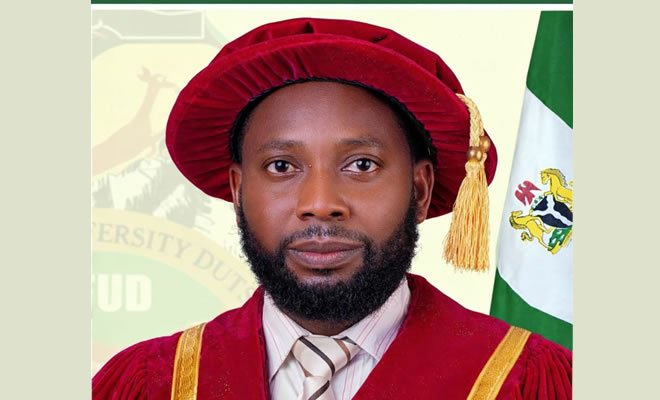
The atmosphere at Federal University Dutse was filled with anticipation and solemn pride on the morning of February 10, 2026, as Prof. Ahmad Mohammed Gummel formally assumed office as the institution’s 4th substantive Vice-Chancellor. The ceremony, attended by principal officers, members of the Governing Council, union leaders, staff, students and invited dignitaries, marked not just a transition in leadership but the beginning of what many described as a defining chapter in the university’s history.
Standing before the university community, Prof. Gummel struck a tone that was both humble and resolute. He began with gratitude to Almighty Allah, acknowledging that leadership is ultimately a trust bestowed by divine will. There was a deep sense of reflection in his voice as he spoke about responsibility, service and collective purpose. Rather than presenting himself as a solitary figure at the helm, he framed his emergence as a shared achievement of a community that had prayed, supported and believed in the vision of progress for FUD.
He paid glowing tribute to his predecessor and mentor, Prif. Abdulkarim Sabo Muhammad, describing him as a guiding force in his academic and administrative journey both in Malaysia and Nigeria. The acknowledgment was heartfelt, suggesting continuity rather than rupture. He made it clear that his administration would build upon the solid foundation laid by his predecessor, sustaining the culture of excellence while introducing reforms necessary for the future.
His appreciation extended to the 4th Governing Council led by Shuaibu Oba Abdulraheem, whose confidence in his capacity, he said, would be justified through dedication, transparency and hard work. He also recognized the support of the Executive Governor of Jigawa State, Umar Namadi, noting that the progress of a federal institution within the state depends in no small measure on collaboration and goodwill.
Yet beyond the acknowledgements, it was his sweeping vision for the university that captured the attention of the audience. Prof. Gummel spoke not merely of administration, but of transformation. He articulated a bold ambition: to reposition Federal University Dutse as Nigeria’s premier hub for research-driven solutions by the year 2030. He envisioned an institution that does not only award degrees but produces knowledge that solves real problems, in agriculture, science, technology, management and the humanities, while nurturing graduates distinguished by both competence and integrity.
His words painted a picture of a university deeply aware of global shifts. He spoke about modernizing curricula to align with National Universities Commission benchmarks and global digital realities. In an era defined by artificial intelligence, data analytics and climate challenges, he emphasized the introduction of forward-looking academic programmes such as AI and Machine Learning, Data Science, Networking and Cloud Computing, Climate-Smart Agriculture, Geology, Optometry, Physiotherapy and Community Health, among others. The message was unmistakable, FUD must not lag behind; it must anticipate the future.
Equally compelling was his focus on research and commercialization. Prof. Gummel announced plans to establish an Office of Research, Innovation and Commercialization to ensure that academic discoveries do not remain confined to journals and conference halls. He spoke passionately about patents, products and partnerships with industries, about turning ideas into impact. For a relatively young institution, this ambition signaled a determination to compete not only nationally but globally.
Digital transformation formed another pillar of his address. He outlined plans to upgrade ICT infrastructure and deploy a university-wide Learning Management System to support blended learning. His vision of a smart campus, efficient, connected and technologically responsive resonated strongly with students who increasingly expect digital flexibility in their academic lives.
Yet perhaps the most human dimension of his speech lay in his emphasis on welfare. He acknowledged that no university can thrive if its students and staff struggle with basic needs. He promised improvements in utilities, healthcare delivery, hostel conditions and recreational facilities. Work-study programmes and artisan skill initiatives would be introduced to empower students economically and practically. He spoke of mental well-being, of balance, which will ensure that students feel supported both academically and socially.
For staff, he pledged timely promotions, professional development opportunities and financial assistance for deserving non-teaching personnel seeking further studies. Housing solutions were also on the horizon, including discussions to secure accommodation near the university’s main gate. These commitments drew visible nods of approval from members of ASUU, SANU and NASU present at the event.
Infrastructure expansion and financial sustainability were addressed with pragmatic clarity. Prof. Gummel acknowledged funding realities and outlined plans to leverage TETFund interventions, public-private partnerships, alumni networks and donor agencies. He also proposed revenue-generating ventures such as research centers, consultancy services, improved utilization of the university farm, entrepreneurship initiatives, a guest house and a university printing press. The approach suggested a shift from reliance to resilience.
Global partnerships too, feature prominently in his roadmap. As he spoke of forging alliances with international donor agencies and world-class universities to facilitate student exchanges, dual degrees and collaborative research. In doing so, he signaled that FUD’s aspirations extend beyond national boundaries.
Perhaps most forward-thinking was his emphasis on environmental stewardship. He is committed to implementing green policies, renewable energy adoption, improved waste management and the establishment of a Sustainability and Climate Innovation Hub. In a region acutely aware of climate challenges, this commitment carries particular significance.
As he concluded, Prof. Gummel revealed that a comprehensive five-year strategic plan had already been prepared and would soon be presented to the Governing Council for approval. The detail and structure of his agenda suggested preparation rather than improvisation.
When he stepped away from the podium, applause echoed through the hall, not merely as a gesture of ceremony, but as an expression of cautious hope. In his calm yet confident delivery, many saw a leader who understands both the weight of expectation and the promise of possibility. His ascent to the helm of Federal University Dutse marks more than a change in office, it signals a renewed determination to shape the institution into a model of research excellence, innovation and community impact in Nigeria and beyond. All eyes are now on this technocract to see how best he can unleash this lofty blueprint.