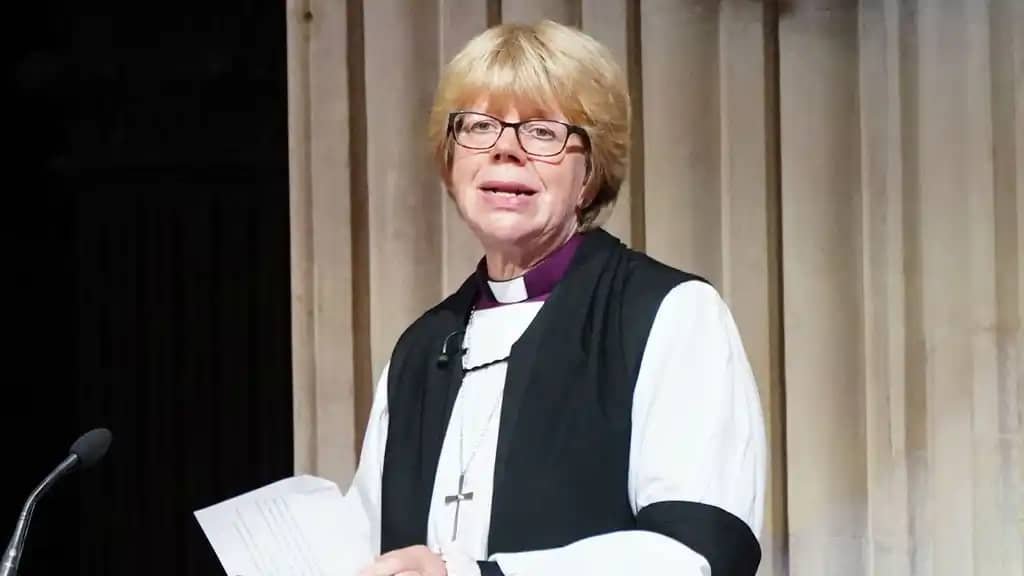
When Sarah Mullally walks into Canterbury Cathedral next spring to be enthroned as the one hundred and sixth Archbishop of Canterbury, she will not only carry the crozier of England’s highest clerical office. She will also carry the prayers, hopes and expectations of countless people who see her appointment as a turning point for both church and society. For the first time in more than fourteen centuries, a woman will sit in the seat of Saint Augustine, the missionary who brought Christianity to England in the sixth century.
It is, by any measure, a story no one could have predicted when Mullally began her working life not with a clerical collar, but in a nurse’s uniform.
“I never set out to climb ladders,” she once remarked in an interview, reflecting on her career. “I set out to care for people.” That vocation of care, whether at a patient’s bedside or at a pulpit, is the thread that runs through her remarkable journey.
Born in Woking in 1962, Mullally’s childhood faith was nurtured quietly but deeply. She studied nursing and specialised in cancer care, fields that demanded patience, courage and compassion. By her mid-thirties she had risen so quickly through the ranks of the National Health Service that she was named Chief Nursing Officer for England at just thirty-seven years old. History records her the youngest ever. Colleagues from that period recall a leader who was firm yet approachable, someone who combined clinical precision with humanity.
But while her professional success was notable, another calling pressed in. At the turn of the millennium, she left behind the security of her health career to train for ordination. Friends described it as “a leap of faith that only Sarah would take. The mission of walking away from the top of one profession to begin again in another.
Ordained as a priest in 2002, she quickly distinguished herself as a thoughtful and compassionate minister. In 2015 she became Bishop of Crediton and just three years later, the first woman to serve as Bishop of London, a role that placed her second only to the Archbishops of Canterbury and York in seniority. “Her appointment then was groundbreaking,” said one London parishioner, “but she never carried herself like a pioneer. She carried herself like a servant.”
Now, at sixty-three, she has been asked to take on the church’s greatest burden of leadership at one of its most turbulent times. The resignation of her predecessor, Justin Welby, left the Church of England reeling after further criticism of its handling of sexual abuse scandals. Attendance across parishes has dwindled, finances are strained, and the Anglican Communion is divided on issues ranging from women in ministry to LGBTQ+ inclusion to the role of the church in secular society.
Mullally does not downplay the challenge. In her first remarks after being named Archbishop-designate, she spoke with honesty and humility: “As I respond to the call of Christ to this new ministry, I do so in the same spirit of service to God and to others that has motivated me since I first came to faith as a teenager.” Her words reflect a tone that many describe as quintessentially her steady, pastoral and grounded in service rather than status.
The symbolism of her appointment has not been lost on anyone. For those who have long fought for the recognition of women in church leadership, her rise is a triumph. For traditionalists who struggle with the idea of women bishops, it presents a challenge. And for ordinary parishioners, it is often something simpler. “When I see her,” said a worshipper from her London diocese, “I see someone who listens. And right now, that’s what the church needs most.”
Beyond Britain, her new role will echo across the global Anglican Communion, a family of churches in more than one hundred and sixty countries. Some provinces, particularly in Africa and Asia, remain staunchly opposed to women bishops. Her leadership will test both her diplomatic skill and the Communion’s fragile unity. Yet supporters believe her background, straddling public service and church life, gives her a unique ability to mediate.
The coming months will be steeped in ceremony. Her election will be confirmed at Saint Paul’s Cathedral in January 2026, followed by the great enthronement service in March at Canterbury Cathedral, a liturgy that blends pageantry with solemnity. Yet behind the grandeur lies the reality of the work before her; healing wounds, rebuilding trust and guiding the church into a future that will look very different from its past.
Sarah Mullally’s story reads less like a climb to power than a lifelong response to need. Whether as a nurse changing dressings, a bishop leading prayers, or soon as Archbishop of Canterbury presiding over one of the world’s oldest Christian traditions, she has always defined leadership as service.
Her journey from the hospital ward where she cared for the body to the cathedral throne for soul care is not just a personal triumph. It is a story that tells us something about the church itself, its struggles, its capacity to change and its search for renewal. And when she walks into Canterbury Cathedral next year to take her seat, it will not simply be the installation of a new archbishop. It will be the embodiment of a church, at long last, opening its most ancient door to the voice and vision of a woman.